
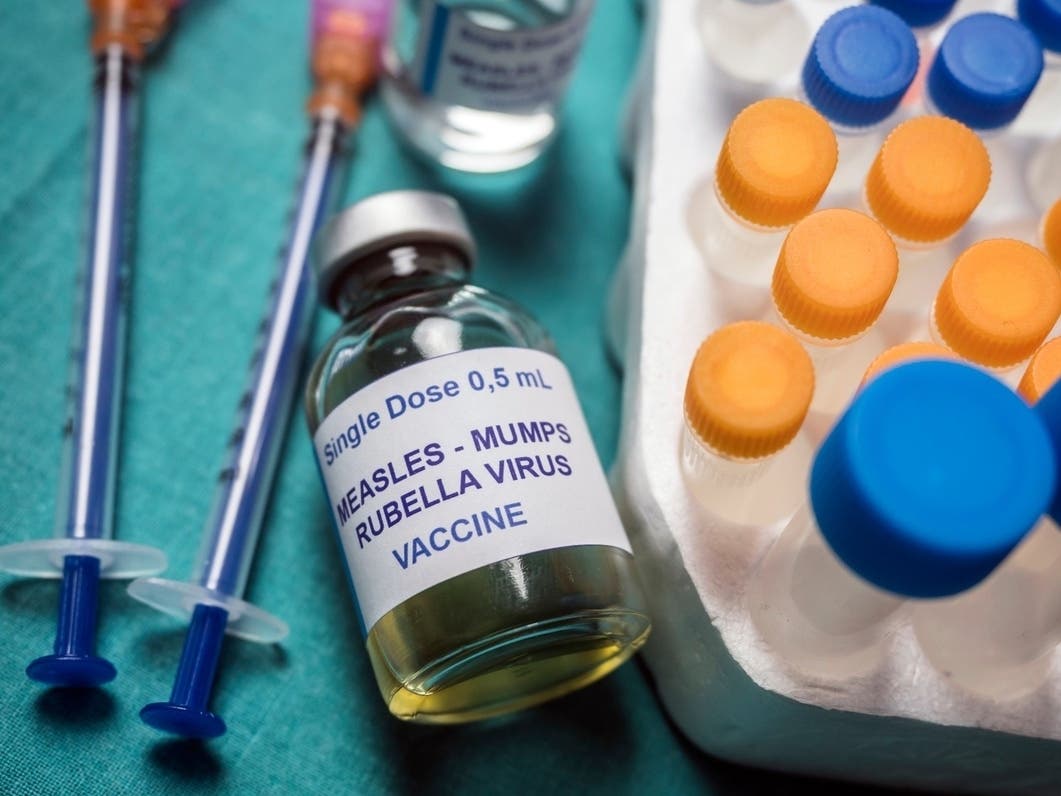
Measles is at a 33-year high as vaccination rates wane nationwide, but changes in data collection may leave some people in Los Angeles County with questions about their risk.
Large swaths of the country are at an increased risk of contracting the highly contagious disease due to falling vaccination rates, according to a study published Thursday in the journal Nature Health. The measles vaccine was first used in 1963 and combined with mumps and rubella vaccines in 1971.
Investigators at Icahn School of Medicine at Mount Sinai and Boston Children’s Hospital conducted a validated volunteer digital survey of 22,062 parents in 3,109 counties from July 2023 to April 2024 to conduct the study.
Counties were then grouped into five risk categories based on predicted vaccine status among children ages 6 months to 5 years of at least one dose of the MMR vaccine: very high risk (less than 60%), high risk (60% to 69%), medium risk (70% to 79%), low risk (80% to 84%), and lowest risk (85% or higher).
An interactive map developed by the researchers allows users to explore county-level MMR vaccination estimates. Across Southern California, county risk levels range from “very high” — such as in Santa Barbara and Imperial counties — to “medium” in Orange and San Diego counties.
Los Angeles County is in the middle, with an estimated 66.5% vaccination rate that puts it in the “high risk” category.
Santa Barbara County — very high risk (estimated 58.4% vaccination rate)Imperial County — very high risk (estimated 58.8% vaccination rate)San Bernardino County — high risk (estimated 61.9% vaccination rate)Ventura County — high risk (estimated 65.3% vaccination rate)Los Angeles County — high risk (estimated 66.5% vaccination rate)Riverside County — high risk (estimated 67.5% vaccination rate)Orange County — medium risk (estimated 70.3% vaccination rate)San Diego County — medium risk (estimated 70.6% vaccination rate)
The California county with the highest estimated vaccination rate is Marin (82.1%), putting it in the “low risk” category.
Current surveillance systems, relying mostly on phone surveys with provider verification or school-entry data, often result in incomplete data and systematically exclude vulnerable groups, the researchers noted.
“Our approach complements existing surveillance systems, including recently published county-level reports of two-dose MMR coverage, by better capturing populations who might otherwise be absent from official reporting, including homeschooled and uninsured children,” they said.
Model-based surveillance, which uses mathematical models to analyze data and predict future trends, “can complement traditional systems by identifying at-risk communities earlier, guiding geographically targeted interventions and strengthening local preparedness, ultimately advancing national vaccine equity and disease prevention goals,” the researchers said.
Measles was declared eliminated in the United States in 2000, but significant outbreaks have occurred in 2019 and 2025.
Last year, measles cases nationwide reached their highest level since 1992, with nearly 50 outbreaks and 2,012 cases in 45 states, according to the Centers for Disease Control and Prevention. Of those, 24 were among international visitors to the United States.
Three people died last year— two unvaccinated children in Texas and an unvaccinated adult in New Mexico. They were the first people to die of measles in the United States in a decade.
Although there haven’t been any outbreaks reported in 2026, the CDC said that as of Jan. 13, there have been 171 confirmed measles cases in nine states, most of them in South Carolina (145). Utah reported 14 cases, and other states — Arizona, Florida, Georgia, North Carolina, Ohio, Oregon and Virginia — reported three or fewer cases. There have been no cases of measles among international visitors so far this year.
MMR vaccine rates among entering kindergarteners have been subsiding nationally since before the COVID-19 pandemic, according to CDC data. During the 2024-2025 school year, an estimated 92.5 percent of kindergartners had been vaccinated against measles, compared to 95.2 percent in 2019.
For highly contagious diseases like measles, a very high vaccination rate of around 95 percent is the benchmark for achieving herd immunity.
One of the most contagious of infectious diseases, measles spreads easily through the air when an infected person coughs or sneezes.
Virus-containing droplets can remain in the air or on surfaces for up to two hours, and one person with measles can infect nine out of 10 unvaccinated people, according to the CDC
RELATED: